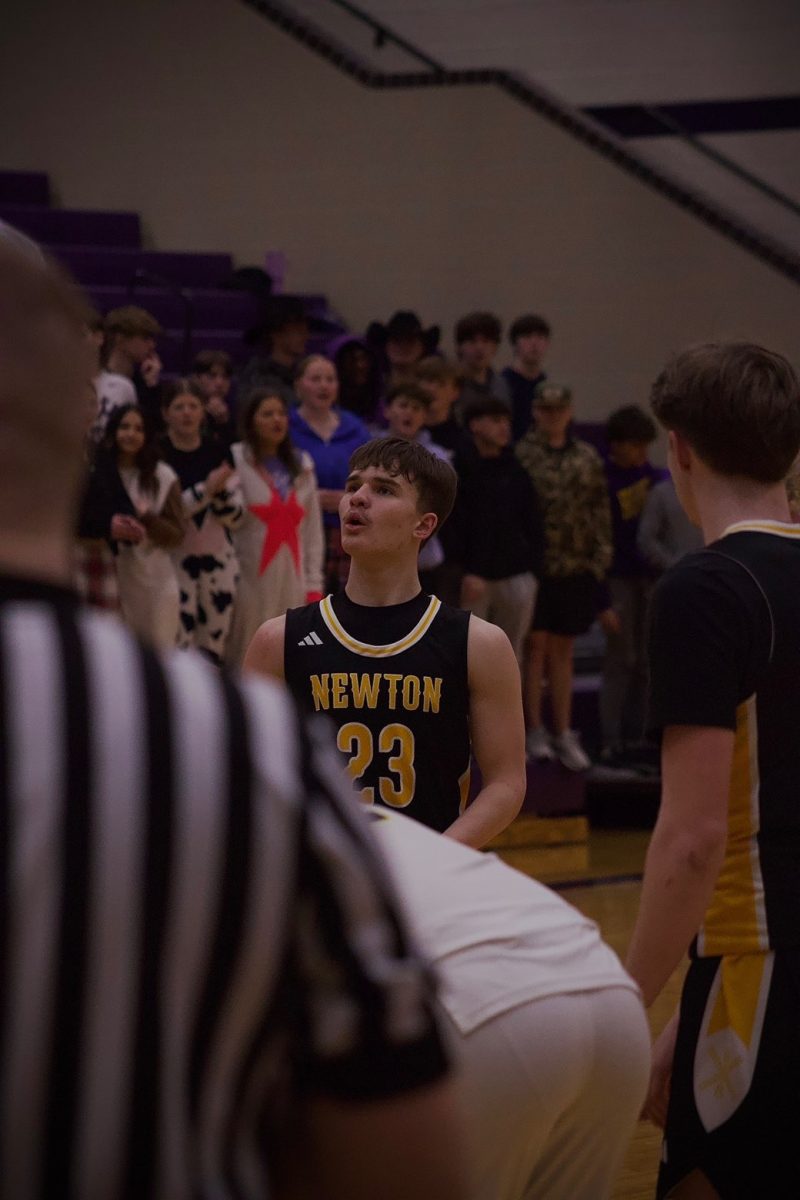
Great power comes with great responsibility, and throughout their high school careers, various sports and club participants have proven themselves responsible enough to earn a leadership position. Different team captains carry a variety of traits, and no leadership story is the same. Senior Maddox Williams has played basketball for 14 years, and he said that he’s had his captaincy since his sophomore year. Williams said his leadership style could be described as directive, and this works for him, perhaps more than others, due to his long-term commitment to the basketball program.
“I’ve been [at Newton] the whole time, and I haven’t wanted to leave here. I came here to change here, not just win and then leave,” Williams said. Relating specifically to basketball, Williams thinks that leaders should be loud and energetic. Senior Ryan Antle has participated in Scholars’ Bowl for four years and received his captaincy in his senior year.
He believes that, in general, leaders should possess good communication skills, teamwork, and humility.
“I would say that as a leader, I just try to be as encouraging as possible and not criticize people for their mistakes, and it’s just developed over time because I’ve made those mistakes also,” Antle said. Senior Emma Gering has played volleyball for six years and took on the team captain role her senior year. She believes that good leadership involves being inclusive, confident, and possessing good listening skills.
As these team captains have developed their own leadership styles, they have gotten the opportunity to reflect on some of the hardships that come with holding such an important role on their teams.
“The hardest part about being a leader is spontaneous decision-making, sometimes with little information,” Gering said. Gering thinks a great example of a challenging situation is quickly adjusting to new lineups. Frustrating and stressful situations can bring impatience, and Antle said that one of the hardest things about being a leader is maintaining a calm demeanor and a functional environment under these circumstances.
Williams argues that the most difficult part of being a leader is the lack of guidance that they receive.
“You’re leading yourself as well as the whole team, so I don’t really have anyone telling me if I’m doing right or wrong,” Williams said. Although captaincy can feel isolating or cause uncertainty, a common tactic is to take after people who have modeled positive leadership in impactful ways. Antle recalls former student Gavin Hadley presenting himself as a positive role model, which has contributed to Antle’s approach to leadership.
Williams attributes his enlightenment and guidance to his father.
“He works pretty hard… and he’s still there to tell me what I’m doing right and wrong,” Williams said. As people grow into their influential positions, they begin to learn more about themselves and what is important to them. Gering believes that being a leader means being a confident and well-rounded player who can lead others in an approachable way.
Williams benefits from holding his captaincy multiple years in a row, which brings solid trust within a team, and he credits his position to the relationships he and his teammates have built around the basketball program.
“I’m trying to evolve kids to be a good person later on in life,” Williams said.
The influence of captaincy is not something that most take for granted.
“I think it comes with a sense of pride that you’ve put in hard work and you’re getting recognized for it,” Antle said.
Despite the frustrations, responsibilities, and isolation that come with leadership, there are always opportunities to make unforgettable memories with peers. Antle said that getting first in one of the most difficult 5A meets of the year was an incredible accomplishment for his undersized team.
These fulfilling experiences last a lifetime for most and usually carry on through future generations of team leaders.
“My proudest achievement is just winning games with my best friends,” Gering said.